Robotic da Vinci surgery
The most advanced form of minimally invasive surgery for digestive cancers: superior precision, incisions of a few millimetres and fast recovery — with the surgeon in full control at every step.
Verified profile · robotic surgery directory →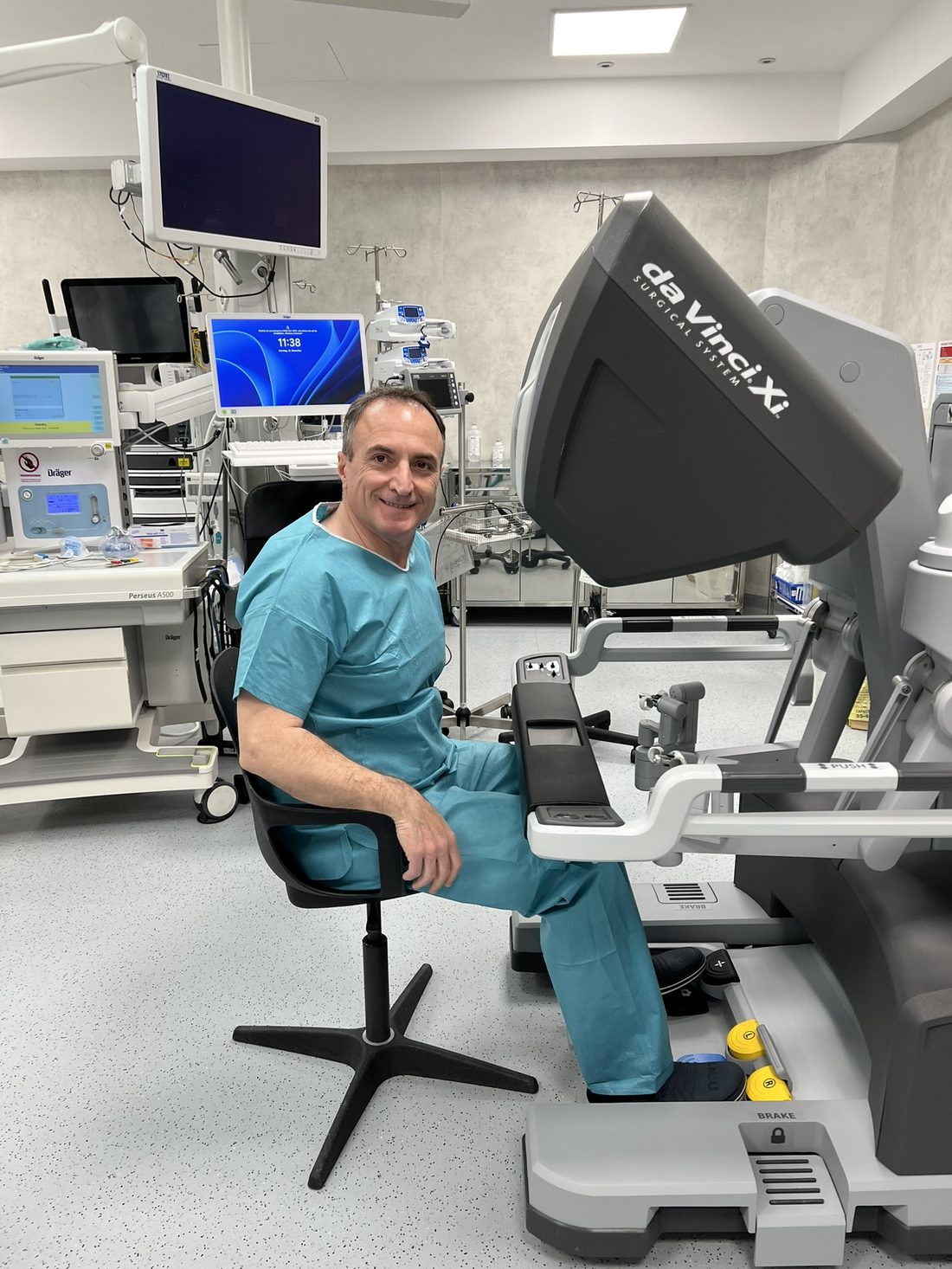
What is the da Vinci surgical system?
The da Vinci system is a surgical platform that allows operating through a few incisions of just millimetres, with a precision superior to conventional surgery. One thing is essential to understand: the robot does not operate on its own and makes no decisions. Every movement is controlled in real time by the surgeon, seated at a console in the same operating room.
The robot is, in fact, an extremely fine extension of the surgeon's hands — an instrument that translates their gestures into movements more precise than would otherwise be possible.
The surgeon's vision, hands and precision — amplified
Magnified 3D imaging
The surgeon looks through a high-definition three-dimensional camera that magnifies the operating field up to ten times. Fine structures — nerves, small vessels — become far clearer than with the naked eye.
Tremor-free, wide articulation
The surgeon's hands operate two controls, and the instruments inside reproduce the movements — filtered of any tremor and with greater flexibility than the human wrist.
Precision in narrow spaces
In difficult anatomical spaces — such as the pelvis, in rectal cancer — the robot offers access and control where precision matters most.
What it means for you
Less pain, minimal scars
Incisions of a few millimetres mean less pain after surgery and almost invisible marks.
Faster recovery
Early mobilisation and a shorter hospital stay, with a faster return to normal life.
Preserving delicate functions
In rectal cancer, precision allows protection of the nerves controlling urinary and sexual function.
Fewer conversions to open surgery
An operation begun minimally invasively is more likely to stay that way, without the need for a large incision.
A synthesis of the evidence
Research over recent years — including large clinical trials and meta-analyses — shows a balanced picture. Robotic surgery reduces the need to convert the operation to open surgery and, in rectal cancer, tends to offer a more complete excision of tissue and a higher number of examined lymph nodes — markers of oncological quality.
For many other outcomes — complications, overall safety, long-term survival — robotic and laparoscopic surgery performed by experienced hands give comparable results. This is in fact good news: both are excellent techniques. Robotics has the drawback of a somewhat longer operating time and a higher cost.
Scientific references
- Jayne D, Pigazzi A, Marshall H, et al. Effect of Robotic-Assisted vs Conventional Laparoscopic Surgery on Risk of Conversion to Open Laparotomy Among Patients Undergoing Resection for Rectal Cancer: The ROLARR Randomized Clinical Trial. JAMA. 2017;318(16):1569–1580.
- Feng Q, Yuan W, Li T, et al. Robotic versus laparoscopic surgery for middle and low rectal cancer (REAL): short-term outcomes of a multicentre randomised controlled trial. The Lancet Gastroenterology & Hepatology. 2022;7(11):991–1004.
- Li X, Xu L, Shen X, Li H. Comparison of surgical outcomes between robotic and laparoscopic surgery for mid-low rectal cancer: a meta-analysis of randomized controlled trials. Journal of Robotic Surgery. 2025;19(1):177.
- Systematic Review and Meta-Analysis of Laparoscopic versus Robotic-Assisted Surgery for Colon Cancer (studies 2020–2024), 21 studies, 50,771 patients. PRISMA systematic review, 2024.
Find out whether the robotic approach is right for you.
At the consultation we discuss the treatment options together, according to your diagnosis and the stage of disease.
Request a second opinion